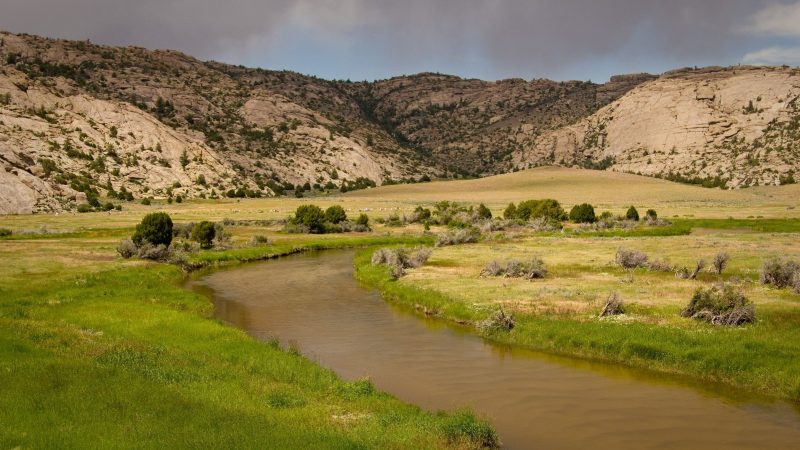
Two companies of pioneers. One of the hardest months in pioneer history. A rescue that would shape Latter-day Saint memory for generations.
The members of the Willie and Martin companies endured cold, starvation, and loss that we cannot truly recreate — and we don't try to. Trek 2026 is not a reenactment of their hardship.
We walk where they walked so we can begin to understand why they walked — why they crossed an ocean and a continent, why they pushed forward when it would have been easier to stop, and why they kept faith in Jesus Christ when everything around them was falling apart. We come to honor them, and to ask the Spirit how we can build that same faith into our own lives.
Read their story below. Then on trek, in your family, on the trail, ask the Lord what He would have you take from it.
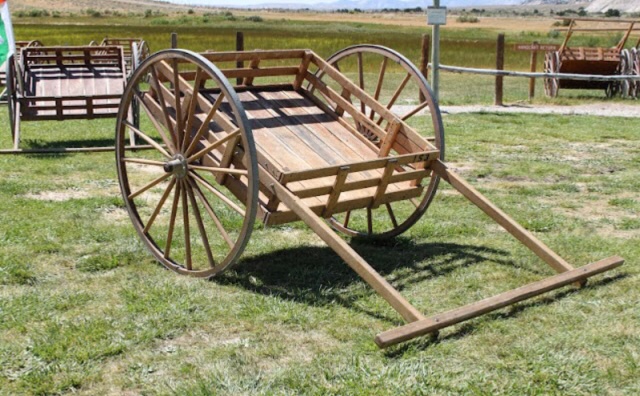
Between 1846 and 1869, roughly 70,000 Latter-day Saints migrated to the Great Basin. The vast majority traveled by ox- or horse-drawn wagons. But from 1856 to 1860, a small group of about 3,000 pioneers — fewer than 5% of the total — made the journey on foot, pulling everything they owned in two-wheeled handcarts.
The handcart plan was an austerity measure. The Church's Perpetual Emigrating Fund had been stretched thin, and thousands of new converts in the British Isles and Scandinavia wanted to gather to Zion but couldn't afford a wagon and ox team. Walking 1,300 miles with a handcart was projected to cut the cost of the journey by about a third.
Ten handcart companies made the journey across those four years. Eight made it safely, with death rates comparable to the wagon trains. Two did not. Those two — the fourth and fifth companies of 1856 — were led by James G. Willie and Edward Martin.
The Willie Company was made up largely of British converts who sailed from Liverpool on the ship Thornton. The Martin Company followed on the Horizon. Together they were nearly 1,100 souls.
| Company | Captain | Approx. Size | Approx. Deaths | Mortality Rate |
|---|---|---|---|---|
| 4th — Willie | James G. Willie (41) | ~500 | ~68 | ~13.6% |
| 5th — Martin | Edward Martin (38) | ~576 | ~135–150 | >25% |
Numbers compiled from historical sources cited at the bottom of this page. Death counts in the Martin Company are estimates because many trail burials were not formally recorded.
About half of all Latter-day Saint emigrants of the era were under twenty. The two 1856 companies in particular included a high concentration of women, children, infants, and elderly converts — many of whom were poor, undernourished, and physically vulnerable before the journey even began.
A cascade of delays in Liverpool, on the Atlantic, and in Iowa City pushed the Willie and Martin companies dangerously late into the season. When they finally reached the outfitting post in Iowa, the handcarts hadn't even been built yet — and when the carts were built, many were made of unseasoned green wood, all that was left.
By the time they reached Florence, Nebraska (modern-day Omaha) in mid-to-late August, leadership had to decide: winter over in Nebraska, or push on?
Sub-captain Levi Savage warned against continuing. He pointed to the women, the small children, and the elderly. He said taking them into the high country this late would be deadly. He was outvoted. When he lost the vote, he pledged to stay with the company anyway and share whatever came.
The Willie Company left Florence on August 16–17. The Martin Company followed August 25–27. Traditional wagon trains were already arriving safely in the Salt Lake Valley while these handcart pioneers were just starting out across the plains.
As the companies pushed through September and into October, the green-wood handcarts splintered. Wheels shrank, cracked, and shrieked against dry axles. Food ran short. Rations were cut, cut again, and cut again — from a pound of flour a day, down to twelve ounces, then to eight, then to four for children and three for infants.
A Willie Company survivor named John Chislett later described the hunger as so intense the pioneers felt they could "gnaw a file."
On October 19, the weather turned. A massive early-winter storm swept across the Rocky Mountains, driving temperatures well below freezing and burying the trail in snow.
That same day, the Willie Company reached the Sixth Crossing of the Sweetwater River — out of food, freezing, and unable to go on. Nine people died at that camp during the storm.
"It was enough to make the heavens weep." — Elizabeth Jackson, Martin Company survivor, on the night her husband Aaron Jackson died on the trail
The rescue began two weeks before the storm did.
On October 4, returning missionary Franklin D. Richards rode into Salt Lake City and told Brigham Young that more than 1,000 immigrants were still hundreds of miles out, on the open trail, in October.
The next day, Sunday, October 5, Brigham Young suspended regular services in the Salt Lake Tabernacle and called for teams, wagons, food, and men. By October 7, the first relief company — led by George D. Grant — was already pushing east. Behind them, more wagons followed.
As the weather worsened, some rescuers and wagons turned back before reaching the handcart companies. Redick Allred refused to abandon his assigned station near South Pass. He stayed with the supplies, keeping a crucial relief point in place for the suffering companies.
When the Willie Company finally crested the brutal climb over Rocky Ridge in a blizzard, it was Allred's wagons that were waiting on the other side. George D. Grant later cheered him with the line: "Hurrah for the Bulldog. Good for hanging on."
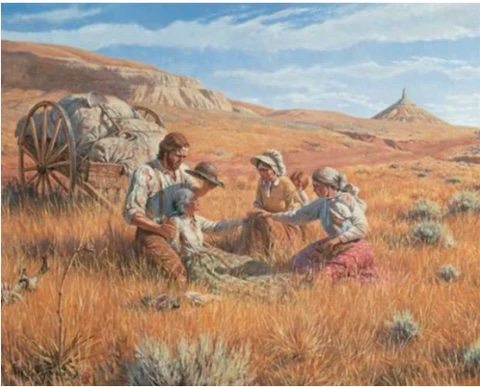
Ephraim Hanks, a frontier scout, said he was awakened one night by a voice calling his name three times — "Eph! Eph! Eph!" — telling him to go help the handcart companies. He went. Riding alone ahead of the main wagons, he found the Martin Company on the trail carrying freshly killed buffalo meat, and used both his frontier skill and his priesthood to administer to the sick. Survivors remembered him as an "angel of mercy."
By the time the Martin Company reached the Sweetwater River near Devil's Gate, they had been exposed to freezing temperatures for over two weeks. The river was thirty to forty feet wide, two to three feet deep, and choked with floating ice. The banks forced a diagonal crossing, making it even longer in the cold water.
Many pioneers, seeing the river, broke down. They simply could not face wading into it.
A small group of young rescuers waded into the river and carried the most vulnerable across — the women, the children, and the weakest of the men. The most popular telling of this story says that "three eighteen-year-old boys" carried the whole company across and then died of exposure. That telling is part folklore. Historians have identified the actual rescuers by name — and all of them survived to live full lives.
| Rescuer | Age in 1856 | What happened after |
|---|---|---|
| C. Allen Huntington | 24 | Survived; lived a full life |
| Stephen W. Taylor | 20 | Survived; lived a full life |
| Ira Nebeker | 17 | Survived; lived a full life |
| David P. Kimball | 17 | Survived; lived a full life |
| George W. Grant | 16 | Survived; lived a full life |
Historians note that many of the able-bodied male pioneers also waded through the freezing water themselves while pulling their carts.
"I don't want any of that — we have come to help you." — A young rescuer at the Sweetwater, reportedly to pioneer Amy Loader when she tried to thank him for carrying her across
One of the most common misunderstandings about this story is that Martin's Cove is where the company was trapped by the storm. It isn't.
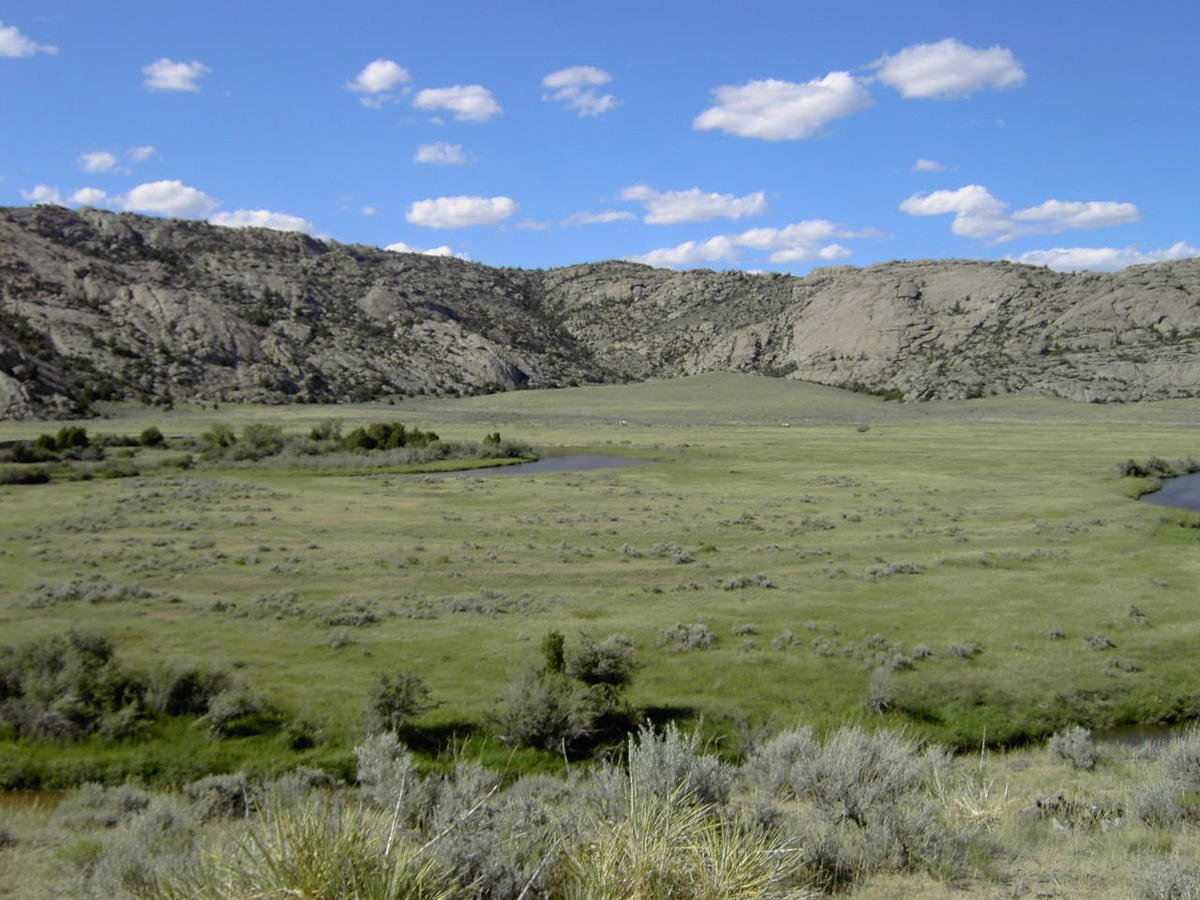
The Martin Company suffered heavily after the October 19 storm and was later found by scouts near Red Buttes / Bessemer Bend, in the area of present-day Casper, Wyoming. Martin's Cove is where rescuers helped them shelter afterward, from November 4 to 9 — a ravine that provided a natural windbreak from the howling open plain.
The company stayed in the Cove for about five agonizing days (November 4–9), waiting for more wagons. Temperatures reportedly fell to roughly 11°F below zero, with about 18 inches of snow on the ground. The rescuers pitched tents, dug for sagebrush, and built fires for pioneers who could no longer do it themselves.
On November 9, when the weather broke slightly, the survivors pushed for Utah. The Willie Company arrived in Salt Lake City on November 9. The Martin Company arrived November 30.
Hundreds of youth and children were among the Willie and Martin pioneers. These are some of their names.
A Scottish boy traveling with his widowed mother and three brothers in the Willie Company. During the Rocky Ridge crossing — a brutal stretch that rose 700 feet over two miles in a blizzard and took the company twenty-seven hours to clear — James was assigned to care for his four-year-old brother Joseph while his mother and disabled older brother pulled the family handcart.
When Joseph became too exhausted to walk, James carried him on his back through the snow. When the two boys finally reached the camp at Rock Creek Hollow and James handed his little brother to safety by the fire, James collapsed and died of exposure and exhaustion. Joseph survived to grow up, become a farmer, and raise his own family in Utah.
A Danish girl traveling alone with the Willie Company to reunite with her older sister in Salt Lake City. At the Rock Creek Hollow camp, she had been assigned to care for smaller children during the ridge crossing.
When she finally reached the camp in the early hours of the morning — cold, hungry, and completely spent — she was sent out into the snow to gather firewood. She was found the next morning, frozen, leaning against a handcart wheel with the sagebrush twigs she had gathered still clutched in her hands.
A small child in the Martin Company. He later remembered his family's tent collapsing under snow in the night, the frozen canvas freezing to his hair. With food gone, the family chewed on tree bark and tried to boil ox hide for nutrients.
After his father died of exposure in Wyoming, Peter was dragged the rest of the way to the Salt Lake Valley by his older brother and sister. He survived to live a long life and become a father of his own large family.
The Hill sisters joined the Church in England against their parents' wishes and saved their own money to make the journey across. Sailing on the Thornton and traveling with the Willie Company, the sisters helped a widow with five children for much of the trek.
During the climb of Rocky Ridge, Julia collapsed in the snow. Emily — barely better off herself — pulled her older sister up and got her over the summit. Both sisters survived. Emily later wrote the words to the hymn "As Sisters in Zion."
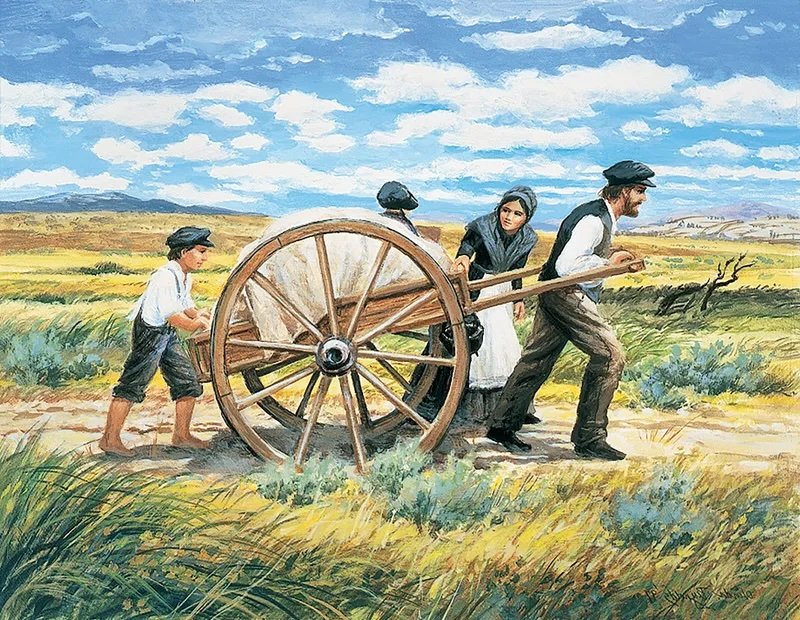
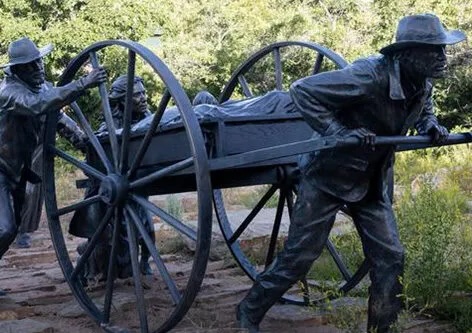
The Willie and Martin handcart pioneers represent fewer than 1% of the Latter-day Saints who crossed the plains. But the image of the handcart pioneer leaning into the wind has become one of the most enduring symbols of pioneer faith — a reminder of what people will endure when they believe they're walking toward Zion, and walking with the Savior.
Today, the Church preserves both Sixth Crossing and Martin's Cove as historic sites — not as monuments to suffering, but as sacred spaces where the courage and faith of those pioneers can be remembered, learned from, and quietly built into the next generation.
That's why we go. Not to recreate what they went through. To honor it, to learn from it, and to ask what it means for our own discipleship of Jesus Christ.
This page summarizes historical material from publicly available sources. For deeper reading: